Eco-friendly Stationery for Corporates Committed to Sustainability

UAE Single-Use Plastic Ban 2026: What’s Changing and What It Means for Businesses
2/13/20263 min read
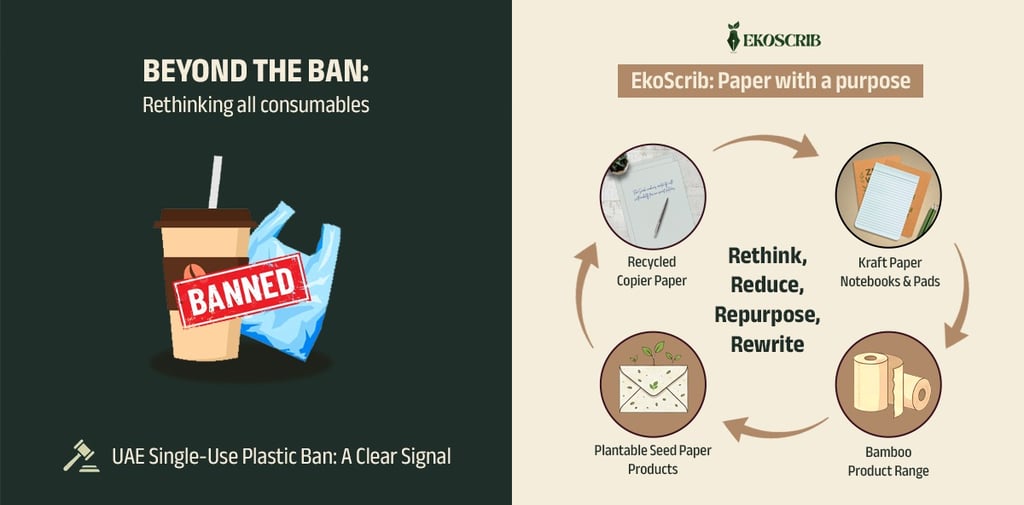

The UAE’s single-use plastic ban is more than a regulation; it is a decisive shift in how we consume, package, and operate. As of January 1, 2026, the country has moved away from throwaway plastics toward a circular, responsible system that prioritises environmental health over short-term convenience.
This shift affects every corner of society, from households and offices to cafés, retailers, event organisers, and industrial suppliers.
Why the UAE Phased Out Single-Use Plastics
Plastic pollution is one of the most visible environmental challenges globally, and the UAE is no exception. Lightweight disposable items often escape waste systems and end up in landfills, deserts, and marine environments, where they persist for centuries.
The UAE’s sustainability roadmap, including Net Zero 2050 and the Circular Economy Policy 2031, recognises that preventing waste is far more effective than managing it after creation. Single-use plastics are low-value, high-impact products, making them an obvious starting point.
The objective is not to inconvenience consumers, but to redesign consumption habits.
What Is Being Banned — Federal Level
Under Ministerial Decision No. 380 of 2022, the UAE has completed its nationwide phase-out.
As of January 1, 2026, the federal ban expands to a broader category of single-use plastic products, covering the import, manufacture, and trade of:
Single-use plastic shopping bags (including those labelled “biodegradable”)
Disposable cups and lids
Plates, cutlery, straws and stirrers
Single-use food containers, including EPS (foam) containers
Other plastic tableware and takeaway items
Note: This also includes a comprehensive ban on single-use bags thinner than 50 microns, regardless of material (including paper).
Federal and local authorities have also made it clear that material claims alone will not be sufficient. Products marketed as “biodegradable” or “compostable” may still be restricted if they are designed for single use and do not meet reuse or recovery criteria.
Dubai’s Phased Implementation
Dubai introduced a structured rollout under Executive Council Resolution No. 124 of 2023:
Jan 2024 – Ban on single-use plastic shopping bags
Jun 2024 – Extension to single-use bags made from other materials
Jan 2025 – Ban on additional plastic items such as stirrers, cups, straws, cotton swabs, and foam food containers
Jan 2026 – Further expansion to plates, food containers, beverage cups and lids, and tableware
Penalties start at AED 200 and can reach up to AED 2,000 for repeat violations.
Are There Exemptions?
Yes. To support trade and essential safety, exemptions include:
Products for export or re-export, provided they are clearly labelled and not sold in the UAE
Bags and products made from recycled materials within the UAE, to support the local recycling industry
Medicine bags and refuse (garbage) bags
Very thin plastic bags are used to wrap fresh food such as meat, vegetables and bread
Large shopping bags are used for items such as clothing, electronics and toys
What This Means for Households
Consumers will notice gradual but clear changes:
Reusable bags become the norm
Fewer disposables
Greater use of paper, fibre, and plant-based materials
Increased emphasis on reuse over convenience
The intention is not to eliminate choice, but to normalise better choices.
What This Means for Businesses
The greatest impact remains on the Retail, F&B, Hospitality, and Facilities Management sectors.
1. Procurement Becomes a Compliance Function
Everyday items, whether packaging, pantry supplies, takeaway containers, or office consumables, will be scrutinised. Selecting the wrong “alternative” could still result in non-compliance.
2. Greenwashing Will Not Survive Regulation
Businesses must demand transparency from suppliers:
Material composition
Thickness and micron details
Conformity with UAE standards
Reuse or recovery pathways
Labels alone will no longer suffice.
3. Sustainability Moves Into Operations
The ban shifts sustainability out of marketing decks and into day-to-day operations, from vendor selection to internal policies. This is where businesses that act early gain an advantage.
4. Education Becomes Critical
Clear communication with staff and customers will reduce friction and build acceptance during the transition.
A Shift Bigger Than a Ban
The UAE’s 2026 “single-use plastic ban” is all about resetting priorities. It asks a fundamental question:
Do we really need products designed to be used for minutes and exist for centuries?
By rethinking everyday materials, from packaging to stationery to tissue paper, let’s encourage a system where products are:
Thoughtfully sourced
Mindfully used
Responsibly disposed of
Materials such as recycled paper, kraft, bamboo, and plant-based fibres are no longer niche alternatives. They are becoming part of the mainstream compliance and long-term solutions.
It is about choosing materials that respect natural resources, systems that reduce waste at the source, and habits aligned with a future-ready economy.
The regulation is the starting point. The real impact will come from the choices businesses and consumers make.
Empowering businesses with affordable, sustainable stationery.
Contact
We Support The SDGs
© 2025. All rights reserved.
Sitelinks


Phone