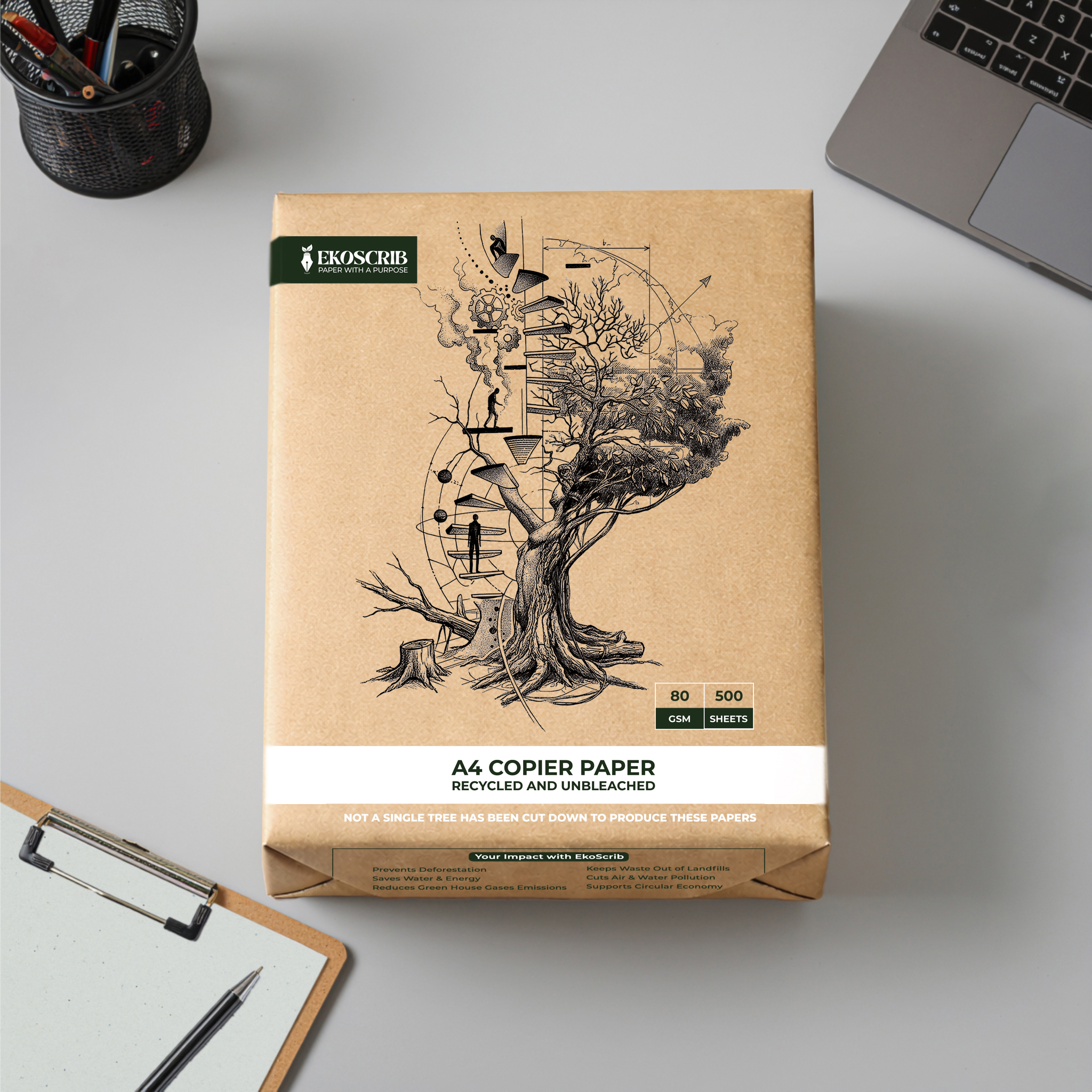
White Recycled Paper vs Unbleached: What's Actually Greener?
Why bright white recycled paper isn't as clean as it looks, and why skipping the bleach makes all the difference.
We all think we know what eco-friendly paper looks like. It's white. Clean. It says “100% Recycled” on the pack. It feels like the responsible choice.
But what if that bright white color is actually undoing part of the good work of recycling?
At EkoScrib, we made a deliberate choice to not be white. Here is why the whitest recycled paper isn't always the greenest.
The Illusion of “Clean” White Recycled Paper
When paper is recycled, it naturally does not come out bright white. Post-consumer waste is a mixture of printed notebooks, old newspapers, packaging, and office paper. Once de-inked and pulped, the resulting raw fiber is naturally not white.
To produce bright, photocopier-white paper, paper mills must take that recycled pulp and put it through additional whitening and bleaching stages to strip away natural tint and residual inks.
“While choosing recycled paper saves trees, requiring it to be bright white adds back a resource-intensive chemical process.”
This is the part most buyers never see. The recycling is genuinely good. It's the extra step after the recycling, the one that makes the paper photocopier-white, that adds cost to the planet without adding anything to the paper's function.
What Does It Take to Make Recycled Paper White?
To turn recycled pulp into brilliant white paper, manufacturers rely on modern bleaching standards:
- ECF (Elemental Chlorine-Free): Replaces toxic elemental chlorine gas with chlorine dioxide. While a major improvement over historical chlorine bleaching, it still utilizes chlorine compounds and chemical processing.
- PCF (Processed Chlorine Free): The true chlorine-free standard for recycled paper. It uses oxygen-based agents such as hydrogen peroxide or ozone. TCF, or Totally Chlorine Free, applies specifically to virgin wood pulp, whereas PCF applies to recycled fiber.
While PCF avoids chlorine pollutants, both whitening processes represent an extra industrial stage. Re-bleaching recycled pulp requires significant additional water consumption and chemical processing, all for a purely cosmetic preference.
Both stages also demand their own rinse cycles. Pulp that's been bleached needs to be washed again before it can be pressed and dried, which is exactly why the “white recycled paper” you buy off the shelf has quietly picked up an entire second manufacturing stage that a plain recycled sheet never needed.
Does the Color Actually Change How the Paper Performs?
This is the question we get asked most, so it's worth answering directly: no, and that surprises people.
Unbleached paper isn't a downgrade. It's simply paper that stopped one stage earlier. In practical terms:
- It runs through standard laser and inkjet printers the same way bleached paper does.
- Opacity and print clarity are a function of pulp quality and GSM, not whiteness. A well-made unbleached sheet at 80 GSM performs the same as a bleached one at the same weight.
- Double-sided printing works the same, with no additional ink bleed-through, because that's controlled by fiber density, not by color.
The only real difference is visual. Unbleached paper carries a soft grey-white or warm beige tone instead of a stark white one. For internal documents, notebooks, and everyday office use, most people stop noticing the tone within a week.
White vs Unbleached Recycled Paper
When evaluating environmental impact, stopping the manufacturing loop earlier yields a cleaner footprint:
| Feature | White Recycled Paper | Unbleached Recycled (EkoScrib) |
|---|---|---|
| Source | 100% Recycled Waste | 100% Recycled Waste |
| Process | Recycling + De-inking + Bleaching / PCF | Recycling + De-inking Only (0% Bleach) |
| Footprint | Higher water, heat, and chemical load | 80% less water used, minimal energy |
| Visuals & Comfort | High glare under direct light | Warm natural tone, low eye strain |
That 80% figure isn't a marketing estimate. It's what stopping the process one stage earlier actually saves at our own production, since the bleaching and its accompanying rinse cycles are the single most water-intensive part of turning recycled pulp white.
Why We Chose to Stay Unbleached at EkoScrib
We started EkoScrib with a simple question: why add chemical processing to make something look “clean”?
We decided to let recycled paper be what it naturally wants to be. Our paper is crafted from 100% post-consumer waste, and we finish processing right after thorough cleaning and de-inking. No bleach, no optical brighteners, no chlorine derivatives.
What you get is the paper's honest, warm natural tone. It is gentle on the eyes, smooth to write on, and it saves an entire chemical stage from entering our ecosystems.
There's also a simpler way to think about this. Every extra stage in a manufacturing process is an extra place for water, energy, and chemicals to get used up before the product ever reaches your desk. Bleaching recycled paper white is the paper industry's version of ironing something that was never wrinkled in the first place. It looks better on a shelf. It doesn't do anything the plain version couldn't already do.
Where “White Recycled Paper” Still Makes Sense
To be fair to the other side of this: there are situations where a client genuinely needs bright white paper, and pretending otherwise doesn't help anyone. Formal external presentations, brand guidelines that specify a paper stock, or printing that needs to match an existing white letterhead are all real reasons to reach for a bleached sheet.
The point of this comparison isn't that white recycled paper is bad. It's that “recycled” and “white” are two separate claims being sold as one, and only one of them is doing the environmental work.
How to Make a Truly Green Choice
You don't have to eliminate white paper entirely from your life, but next time you stock up on stationery, keep these two guidelines in mind:
- Ask if you need white. For everyday notes, journaling, printing, and drafts, unbleached paper offers superior eye comfort and the lowest possible carbon footprint.
- Look for PCF certification. If a project genuinely requires white recycled paper, specifically look for Processed Chlorine Free (PCF) rather than generic “white recycled” labels, which can still mean chlorine-based ECF bleaching.
Ready to Experience Unbleached Paper?
Discover 100% post-consumer recycled paper crafted with 0% bleach or optical brighteners.
Continue reading